Popcorn Removal
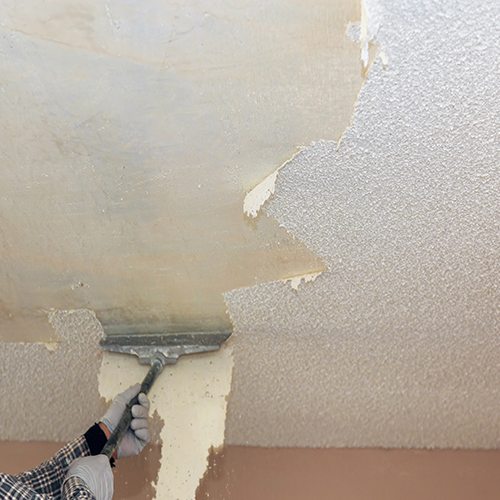
Many homes built in the late 1930s through the 1990s have popcorn ceilings or some type of texture applied overhead. It was used to cover up a lot of flaws in the ceiling. It was time-effective and cost-efficient. Often called an acoustic ceiling, it also served the purpose to absorb sound and reduce noise. These ceilings resemble cottage cheese. You’ll essentially have bumpy stuff stuck to your ceiling. Some have 1970-era sparkles embedded in them. Some popcorn ceilings contain asbestos. Asbestos is a generic term used to describe any of six naturally occurring fibrous materials. Because of its positive qualities, such as its strength and heat resistance, it was widely used in building construction beginning in the late 1800s. It was commonly used for things like fireproofing material for steel beams and columns, added to concrete, asphalt, floor tiles, pipes, and as a component in mixtures for sprayed-on ceilings and walls.
It was a common ingredient in popcorn ceilings but because of its hazard to health, it was banned in 1977. However, many companies still continued using left over materials containing asbestos for another year or so.
Asbestos fibers can cause lung disease, scarring of the lungs, and lung cancer when inhaled in large quantities. But asbestos isn’t dangerous if it’s undisturbed or contained. Also, not all asbestos is created equal. Of the six types, some are far more dangerous to your health than others.
You might not want to run the risk in your home all the same. You can’t tell if a surface contains asbestos unless you test it. It’s not visible to the naked eye. You’ll have to obtain a sample of the ceiling and send it to a laboratory that specializes in identifying asbestos.